The verdict: keep a working FT-5000; buy Ares for a rack, not for its headline price
A working REP FT-5000 2.0 does not need replacing just because Ares 2.0 exists. The FT-5000 2.0 provides two independent adjustable cables, 86 inches of listed cable travel and a nominal 112 lb per handle from its 224 lb stacks. Ares solves a different problem: adding cable work and dedicated pulldown/row connections to a supported PR-4000 or PR-5000 rack. Choose it when those back-training stations and rack integration justify the installation, not because an attachment price looks lower than a complete gym.
For a new standalone purchase, compare the current Arcadia and Arcadia Max. The compact Arcadia suits accessory work and a lower upfront budget; the larger Max gives more width, higher trolley reach and longer travel. An FT-5000 2.0 remains a serious used-machine candidate, but only when the actual unit, price and parts position make sense. REP's old FT-5000 2.0 product URL now leads to its cable-machine collection rather than a current buy-new FT-5000 offer.
Our upgrade choice is Ares 2.0 for a compatible rack owner who wants both adjustable cables and substantial pulldown/row capacity. Our default new standalone comparison is Arcadia versus Arcadia Max, not Ares without its required rack. Athena is the alternative when adding side-mounted cable work is enough and you do not need the Ares back-training arrangement.
FT-5000 and FT-5000 2.0 are not the same used purchase
The FT-5000 name covers more than one generation. REP's original comparison describes 16 adjustment positions on the earlier model and 21 on the 2.0, aluminium replacing plastic pulleys, a smaller redesigned trolley, changed cable ends and 86-inch cable travel on the 2.0. An advertisement saying only FT-5000 is not enough to identify those features.
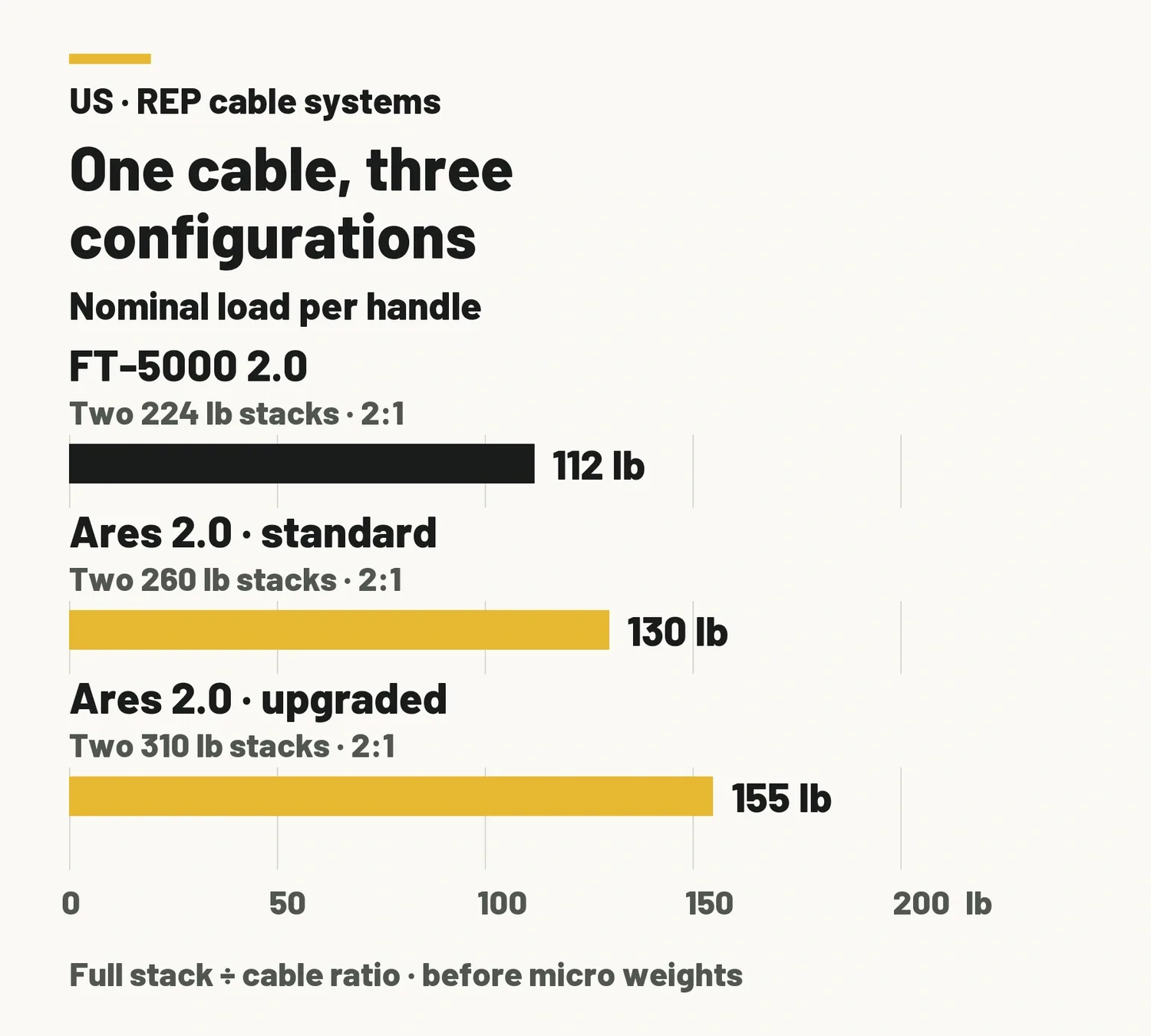
The 2.0 has two 224 lb stacks at 2:1. That means a nominal 112 lb at each handle, not 224 lb in one hand. REP also specifies four 2.75 lb micro plates; one such plate changes nominal resistance by 1.375 lb at a 2:1 outlet. That is useful when a full selector step is too large for an accessory movement. Do not confuse the stack's physical weight, the combined weight of both stacks and what one cable delivers.
For a used buyer, value the exact generation and complete equipment. Inspect both full cable paths for damage, check the trolley pins and selector mechanism, and establish whether the original micro plates and handles are present. A machine that needs replacement cables is a different purchase from one ready to use. For identification, count the trolley adjustment positions and photograph the trolley, pulley material, cable ends and any model label. Match that evidence to REP's 16-position original versus 21-position 2.0 comparison rather than trusting a seller's title. Use REP's current customer-support route with those photographs, the original order details if available and the part needed; request the matching assembly guide and part number before agreeing a used price. A response confirming the exact replacement matters more than a generic parts-store link. A current Ares cable is not automatically an FT-5000 spare. For an owner whose cables, adjustments and loading still meet the routine, keeping the FT-5000 avoids an expensive change of furniture without adding a wanted exercise.
A standalone trainer is not automatically a lat-pulldown machine
The FT-5000 2.0 can support cable pulling exercises, but it has no dedicated thigh restraint or designated low-row footplate. REP's comparison with Adonis makes that distinction explicit. You need a seat or bench for seated pulldowns, and the absence of a restraint becomes part of the exercise setup rather than disappearing because the stacks are heavy. A handle at the lowest trolley position is not the same station as a braced seated row.
Ares adds dedicated high and low connections, an adjustable row footplate and a way to use both stacks for a central pulldown or row. Its standard 260 lb stacks yield a nominal 130 lb per side at 2:1; the optional 310 lb stacks yield 155 lb per side. Using both stacks through the approved joined arrangement changes the total available load, but it does not turn either single outlet into a 1:1 cable.
Adonis is the named alternative when one strong pulldown/row tower matters more than two adjustable front trolleys. REP distinguishes its 1:1 dedicated lat/row connections from the 2:1 adjustable trolley. Do not compare a single Adonis tower with a dual-sided standalone trainer as if both provide the same two-handle fly setup.
Resistance, travel and the settings you can actually use
Cable travel is the distance available at the cable end, not the height of the frame. Ares 2.0 on an 80-inch rack lists 71.3 inches; the 93-inch configuration lists 94.9 inches. That is 23.6 inches more travel on the taller version. Choose the shorter rack because the room requires it, not because you assume only the pull-up height changes.
The Arcadia's 170 lb standard stacks give a nominal 85 lb per hand; its 220 lb upgrade gives 110 lb. The Max starts with 220 lb stacks and offers a 270 lb upgrade, or 110 and 135 lb nominally before its add-on weight. REP's Max figures of 112.5 and 137.5 lb include the micro-weight. Those figures are not directly comparable with an FT-5000 maximum that excludes its small add-ons.
All four choices below use 2:1, but they differ in minimum settings, travel and trolley range. For an exercise needing a nominal 120 lb in one hand, standard Arcadia and FT-5000 2.0 are not the right purchase; standard Ares is within its stated range. For lighter accessory work, Arcadia's 10 lb nominal minimum and 2.5 lb add-on effect can be more relevant than the maximum stack. The table gives specification arithmetic, not friction-adjusted measurements.
| System | Stack per side | Nominal per-handle ceiling | Listed cable travel | Adjustment positions |
|---|---|---|---|---|
| FT-5000 2.0 | 224 lb | 112 lb | 86 in | 21 |
| Arcadia | 170 lb; upgrade to 220 lb | 85 lb; upgraded 110 lb | 81 in | 32 |
| Arcadia Max | 220 lb; upgrade to 270 lb | 110 lb; upgraded 135 lb | 93.4 in | 36 |
| Ares 2.0 | 260 lb; upgrade to 310 lb | 130 lb; upgraded 155 lb | 80 in rack: 71.3 in; 93 in rack: 94.9 in | Depends on exact rack/upright setup |
Arcadia versus Arcadia Max: buy room and travel before extra stack plates
Arcadia Max is the better new standalone choice when cable flies, high pulley placement or movement away from the frame is the constraint. REP lists 75.5 inches of front width on the Max versus 55 inches on Arcadia, 93.4 versus 81 inches of travel and 36 versus 32 height positions. The Max exterior is 44 inches deep and 87.6 inches high, with trolley positions from 12.8 to 77.5 inches. Those are useful physical differences; they still do not promise fit for every body or bench.
The compact Arcadia is the better-directed spend if its movement positions and 85 lb standard nominal ceiling already cover your work. Upgrading its stacks to 220 lb per side makes it a heavier compact trainer, not a wider one. A buyer who adds weight to solve a lack of reach has spent money on the wrong constraint.
For an FT-5000 2.0 owner, Arcadia is therefore a sideways move unless its smaller frame or newer adjustment arrangement solves something concrete. The Max offers longer listed travel and more settings than the FT-5000 2.0, but do not replace a functioning trainer solely for the word Max. A trial of the exact exercise position can settle whether those additional settings are useful to you.
Ares 2.0 compatibility: the rack is part of the purchase
Ares is a no-buy for an unsupported existing rack, even if the uprights look close. REP does not guarantee fit on another brand: hole patterns, metric dimensions and other interfaces differ. The inspected US six-post family supports PR-4000 and PR-5000 configurations; the UK listing's live selector is PR-5000 only. Do not use the broader copied compatibility prose to invent a UK PR-4000 SKU you can order.
Depth notation such as 30:16 describes the main training section and rear section, not a single 46-inch clear exercise space. Four-post Ares uses a different attachment configuration, and the 16-inch version requires Mini Front Foot Extensions front and rear. It is not a shortcut for mounting the six-post product on any four uprights.
Existing equipment can also change the basket. REP recommends one 4000 Series leg roller or two 5000 Series leg rollers to restrain the thighs for pulldowns. Those do not appear simply because the Ares frame is in the cart. Match the exact rack series and selected configuration before pricing the upgrade; if the rack is wrong, a standalone trainer is a cleaner purchase than an unapproved adapter project.
| Market / rack | Six-post depth configurations in inspected listing | Height selection | Purchase consequence |
|---|---|---|---|
| US PR-4000 | 16:16, 24:16, 30:16, 41:16 | 80 or 93 in | Select matching Ares 2.0 series, height and depth |
| US PR-5000 | 16:16, 30:16, 41:16 | 80 or 93 in | Do not select PR-4000 hardware |
| UK PR-5000 selector | 16:16, 30:16, 41:16 | 80 or 93 in | UK offer is not the entire US configuration menu |
| AU PR-5000 retailer | 80 x 30, 93 x 30, 93 x 41 size menu; six-post rack required | As selected | Inspected offer is out of stock |
| Another brand / unsupported rack | Not manufacturer-guaranteed | Not applicable | Do not buy Ares as a presumed fit |
What Ares 2.0 changes inside the rack
Ares 2.0 moves its weight stacks rearward and routes cables along the bottom of the rack so the trolleys can park low while you use the uprights for barbell work. That matters especially on shorter uprights, where a trolley parked high can compete with your J-cup position. Integration still means sharing one physical rack, so cables and barbell attachments have to be parked deliberately rather than left wherever the previous set ended.
The raised low-row connections are a more meaningful improvement than another handle in the box. In Garage Gym Reviews' assessment, Coop Mitchell found the original Ares low-row cables came around the heels awkwardly; the 2.0 raises the connections and brings them closer together. That is his test observation, not ours. It explains why a seated row is a reason to choose the 2.0 rather than treating both generations as interchangeable.
The footplate has cutouts that let specified REP benches sit centrally and deeper inside the rack for flat and incline pressing. The manufacturer names BlackWing, AB-3000 2.0, AB-5000 2.0 and Nighthawk. A cheaper bench is not automatically one of those supported centering fits. Plan where the bench sits for the row, where it parks for squats and where it moves for pressing. If it blocks your approach to the J-cups, the extra capability has not created a second independent training bay.
One session shows whether integration helps or gets in the way
For an Ares session moving from squats to pulldowns and then rows, first finish and park the free bar and its plates. Reposition any J-cups or rack attachments that obstruct the cable task. Put the bench or seat and correct leg restraint into the pulldown arrangement, then connect the selected handle to the dedicated high outputs. Use the manufacturer-approved adapter when joining the two stacks; one central handle is not permission to improvise a connector.
For the row, move the bench into its row position, set the footplate and change to the low outputs. For a following single-arm accessory exercise, return the central attachment to storage and use the appropriate adjustable trolley. Set trolley height and resistance separately. REP's Ares instructions require the securing pins in the trolleys during use; selecting a stack plate is a different action from securing trolley position.
A standalone FT-5000 or Arcadia leaves the squat rack available without this clearing process, although it occupies another floor position. That is the decisive comparison for two people training together. REP permits independent simultaneous cable use on Ares, but two users on its cable sides are not proof that a third person can safely use the same barbell space. Keep concurrent use within the layout and use permitted for the configuration, rather than treating every pictured station as another person.
The US bill: cable-only, rack-owner upgrade and a new rack are different baskets
The US Arcadia lists $2,199.99 and Max $2,699.99. Both provide cable work without buying a power rack. Adding the listed $269.99 AB-3100 bench gives equipment subtotals of $2,469.98 and $2,969.98. That bench adds supported seated and pressing positions; it does not add a thigh restraint, a dedicated row footplate or Smith bar. Choose a bench only if those positions appear in your work, rather than adding it to make a cable-only basket look more complete.
The Arcadia stack upgrade is $324.99, making the machine $2,524.98 before a bench. The Max upgrade is $329.99. Spending on that heavier compact Arcadia still does not buy the Max's width or travel. These are US equipment examples, before applicable tax, assembly, access work or delivery beyond the seller's stated shipping service. Listed prices are not an assertion that every colour is available.
For a compatible US PR-4000 six-post owner who already has a suitable bench and barbell setup, the $2,999.99 Ares attachment plus one listed $99.99 4000 leg roller makes $3,099.98 in upgrade hardware. That is a coherent owner upgrade, not the price of a new complete rack gym. A PR-5000 buyer needs the correct pair of 5000 rollers instead; the price of the 4000 roller must not be reused for that pair.
For someone starting without a rack, Ares also requires the selected compatible rack, J-cups, safeties, bench or seat, restraint and any barbell/plate/collar equipment needed for free-weight work. REP's $1,499.99 starting PR-5000 builder price is not a completed six-post Ares basket. Do not add it to the attachment and present the result as a fitted rack-and-cable package. If you only want cables, the standalone figures above already buy the actual job without that extra construction.
| Buyer / configuration | Equipment subtotal | What it buys |
|---|---|---|
| Cable-only, Arcadia | US$2,199.99 | Standalone two-stack trainer; supplied D-handles |
| Cable-only, Arcadia Max | US$2,699.99 | Larger standalone two-stack trainer |
| Arcadia with AB-3100 bench | US$2,469.98 | Cable trainer and bench; no dedicated restraint/row station |
| Arcadia Max with AB-3100 bench | US$2,969.98 | Larger cable trainer and bench |
| Compatible PR-4000 six-post owner, base Ares and 4000 leg roller | US$3,099.98 | Upgrade hardware; existing rack, bench and barbell equipment retained |
UK and Australia are separate Ares purchases
The UK Ares 2.0 six-post PR-5000 attachment lists £2,749.99, with mainland-UK shipping included in the seller's offer. That figure excludes the rack and is not a room-installed gym price. The PR-5000 builder starts at £900, but its cheapest configuration is not evidence of the required complete six-post purchase. Preserve a usable owned rack; if you need to buy one, compare the completed configuration rather than two headline starting figures.
The Australian Gym and Fitness offer is A$5,499 for the PR-5000 six-post attachment and shows its selected sizes out of stock. It lists an A$499 stack upgrade. The relevant decision today is whether to retain your working equipment or buy an actually available local alternative, not to budget a fictional delivery date for Ares. A UK dispatch statement is not an Australian restock promise.
For both markets, the 80-inch and 93-inch choices are different travel options as well as different rack heights. Do not convert a US Arcadia price into a local offer, or assume that every US rack series and accessory is carried by the local seller. The attachment should be supported by the same exact-configuration quote as the rack it will live on.
Ownership: do not buy a maintenance problem to gain another station
Ares installation is not a matter of hanging two pulleys on the outside of an assembled rack. REP's Rev K instructions cover separate 4000/5000 hardware, cable routing, stack assembly and final adjustment. They call for assembly by two or more adults. An existing rack can need partial loosening and reassembly, so count the disruption to the gym as well as the attachment invoice.
The maintenance instructions say to clean the guide rods and reapply silicone spray every three months or as needed. They distinguish cable rubbing, loose hardware and cable-tension adjustment rather than treating every rough pull as a need for new pulleys. Frayed or worn cables are a stop-use problem, not an acceptable characteristic of a cheap used purchase. Use the current Ares-specific support and parts records when diagnosing Ares, and retain separate FT-5000 model information for the standalone machine.
REP says an original Ares cannot be converted to 2.0 by exchanging a few parts. A 1.0 owner should therefore compare the whole replacement cost and dismantling job with the actual improvement sought. If the existing row setup does not bother you and cable capacity is sufficient, replacing it for a generation number is difficult to justify. That same test protects an FT-5000 owner from an upgrade that only changes where the cables stand.
Before reusing an older PR-4000 or PR-5000 rack, check its strap-safety brackets against CPSC recall 21-721. It covers PRA-4120 and PRA-5122 brackets sold from April to December 2020. Stop using affected brackets and follow the free-replacement remedy. This is a rack-accessory issue, not a recall of the FT-5000 or Ares 2.0 cable system.
Use REP's current Ares 2.0 manual and spares links
Check the affected REP rack strap brackets and recall remedy
The final choice by equipment you already own
Keep FT-5000 2.0 if its adjustable cables, nominal loading and 86-inch travel already fit your work. Treat a used FT-5000 as a generation-specific purchase with a real parts and transport bill, not a current-new discount taken from an old review. Buy Arcadia for a compact, lower-cost standalone cable station; buy Max when the extra width, trolley reach and travel solve a real limitation.
Buy Ares 2.0 when a supported REP rack is already the centre of the room and you want its dedicated high/low stations as well as adjustable cables. Choose Athena instead when side-mounted accessory work is enough: its default $949.99 listing is one side, not a dual-stack complete trainer, and it does not justify pretending you bought Ares's whole back-training arrangement. Choose Adonis when a strong dedicated pulldown/row tower is the priority rather than a dual-cable fly station.
If a Smith machine is essential, none of the base configurations compared here includes one. A combined machine from Force USA belongs in that separate comparison; buying a functional trainer and hoping the missing guided bar can be ignored is not a saving. The best REP purchase is the one that adds the missing job while keeping useful equipment you already own.